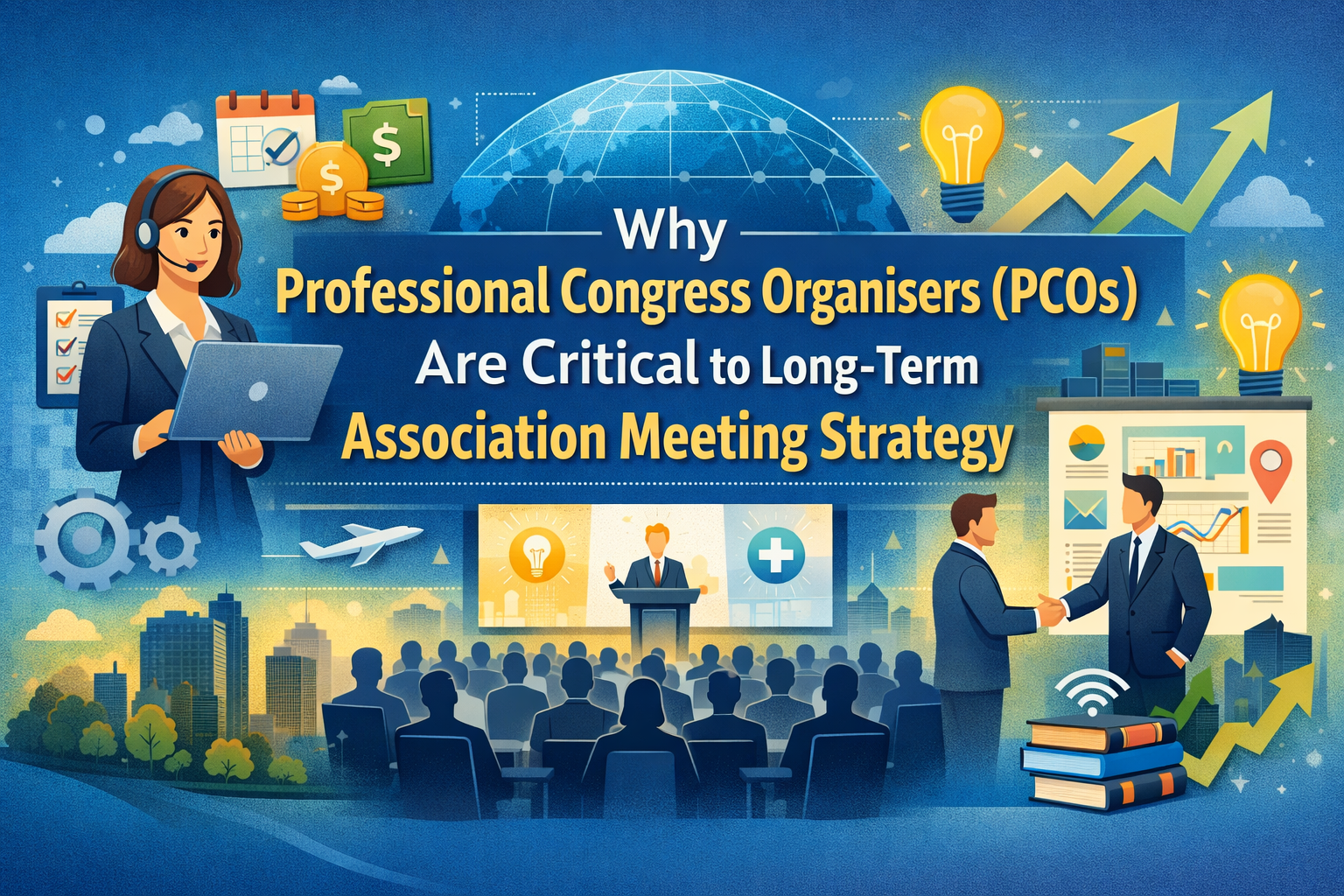
Apart from merely being operationally sound, the meetings of associations should also add strategic value to an organization. Events such as Conferences and Congresses are no longer just one-time meetings, but rather, long-term investments that impact an organization’s member engagement and position in the marketplace. Due to this growing shift, organizations are looking for more knowledgeable partners who can help them think about the operational, as well as the strategic aspects, of the association’s form of the meeting process. PCOs (Professional Congress Organizers), have the largest impact in helping associations organize meetings that impact the long-term success of an association rather than just short-term goals.
The Value of Professional Event Partners
Before, attendance and well-organized events were the two measures of success for an association’s event. Now, the criteria has expanded to include additional measures of success such as the transfer of knowledge among attendees, engagement of stakeholders in the event, a financially sustainable model for the event, and the legacy of the event after it is over. There has also been a shift in the timeline in planning for a meeting. Associations need to think three to five years ahead, and plan their events based on the organization’s mission and advocacy goals, and the expectations of members, etc.
Professional Event Partners provide the knowledge and expertise associations need in planning and organizing their events. Not only do Professional Event Partners guide associations through the process of developing the right venue and registration processes, but they also provide associations with the tools to create a framework for future meetings. This means doing historical analysis of data, and using that data to develop ways for meeting organizers to create meetings that will be meaningful to the attendees. By doing this, organizations will be able to develop meetings that are built to be sustained over time.
Read about What Do Professional Congress Organisers Do and Why Are They Important?
Governance and Continuity Support
The governance structure of an association may be subject to changes due to member turnover and the movement of chairs every few years. Staff may also have more than one responsibility to fulfill, which may lead to gaps in the institutional knowledge of the organisation. Consequently, information regarding the planning of external events may not have the same level of continuity as it does for other aspects of the association.
Professional Congress Organisers (PCOs) can play a vital role in providing continuity of knowledge related to events through documentation, supplier relationships, finances, and risk management that does not change with each new leadership group. Thus, this continuity helps allow associations to continually improve their events based on previous experiences rather than having to restart from scratch each time a new committee is formed.
Risk Management and Financial Sustainability
In order to be successful long-term, effective financial oversight will be required for any organisation when planning meetings over time. An association must be able to absorb increased costs, reduced sponsorship revenue, and erratic attendance numbers – therefore ensuring that the members of the association still receive the same level of benefit they expect from their membership. Poor financial planning does not only affect the finances of the individual event but also impacts the overall viability of the organisation itself.
A PCO with sufficient experience has systems for budgeting, forecasting, and reporting in place that enable the association to maintain a viable financial position over time. A PCO may assist an association to establish multiple sources of income via sponsors, exhibitions, and varying levels of registration fees. Additionally, having the ability to identify potential risks early on will enhance an association’s ability to make informed decisions regarding the future of their meetings and events.
Utilising Digital Technology Strategically
With the digitisation of events, technology has become a key element of how we as professional organisations connect to our members and their participation with our organisations by providing tools to manage our organisation´s meetings digitally and register for events digitally as well as provide tools for hybrid delivery of events, such as event director and cloud-based event systems. This has completely changed the way we connect with our membership – both prior to and during our events – and is now a key part of our membership experience. An association that chooses to implement technology independently often ends up having a number of disjointed systems, and ultimately provides a substandard experience to its members.
If associations take a strategic approach to their usage of meetings and event technology, by building systems to be consistent with their long-term goals, they can ensure that technology supports their mission rather than supporting short-term needs. A strategic approach to technology should also result in improved data collection about delegates and allow associations to provide improved year-round engagement through their use of digital technology. When there is alignment between technology and content strategy and between technology and audience expectations, meetings can evolve from being temporary engagement opportunities to becoming continuous engagement opportunities.
Impacting Knowledge Transfer and Creating Legacy
The primary purpose of an association meeting is to transfer knowledge. Findings of scientific study, best practices for use in the industry and discussions about policy issues are often developed and presented at a conference or meeting and are then incorporated into the conversation in the future. To maximise this legacy, meetings must be designed with the future in mind.
The Association Meetings Strategy provides the framework for an association’s meeting programme to ensure that every detail is planned and executed with care. A strategic approach to planning allows associations to choose their content wisely, choose their presenters based on appropriate topical experience and objectivity, and produce output of value in terms of providing a record of the event (i.e., published Proceedings, video, and author-produced Position Papers) to increase the life of the event.
Building Stakeholder Relationships
Associations are part of a complex matrix of stakeholders including their members, sponsors, exhibitors, destination partners, and industry bodies. For long-term success, associations must create and maintain strong, trust-based relationships with their stakeholders. Meetings are typically the primary way that associations build upon and strengthen those relationships.
Expert event planners provide associations with the opportunity to take a holistic view of their stakeholders’ interactions with one another and with the association to create win-win situations for everyone involved in the meeting. By developing sponsorship packages that provide measurable value to the organisation, providing opportunities for substantial networking, and providing ongoing communication throughout the various meeting cycles, an expert event planner helps to foster loyalty to the association and builds a foundation for the association to be widely recognised as a credible and professional leader in its respective field.
Adapting To Changing Expectations
Over the past few years, the delegate’s expectation of participating in an event has changed significantly. This change is due to the evolution of many aspects of the global economy that affect the way we travel, are concerned about sustainable travel, and experience events and meetings digitally. If associations do not adapt to these changes, they may experience decreased attendance and engagement at their events. With long-term planning, organisations will have the ability to proactively adjust to these trends;
Organisers that focus their efforts on developing both global trends/insights (e.g. Sustainability Initiatives, Accessibility Improvements, Digital Engagement (via M&E Technology)) and implementing these insights across multiple events have a competitive advantage. By focusing on the future, these organisations create relevance for their association members and continue to maintain competitiveness for the foreseeable future.
In Conclusion
Associations today must provide far more than an operationally efficient meeting experience. Additionally, they must have a clear focus on how the association’s missions, goals, and long-term relevance will support the Association’s Financial Sustainability and Member Stakeholder Engagement. PCOS are experts in this area; therefore, they are equipped to provide this level of expertise to associations and their members. By leveraging the above mentioned strategic insight, as well as operational expertise, PCOS can help associations move from an event-centric view of meetings/meetings to a long-term strategic asset view of meetings/meetings through the establishment of continuity, Financial Disciplined Planning, Technology Enabled Planning and Legacy-Based Planning.