
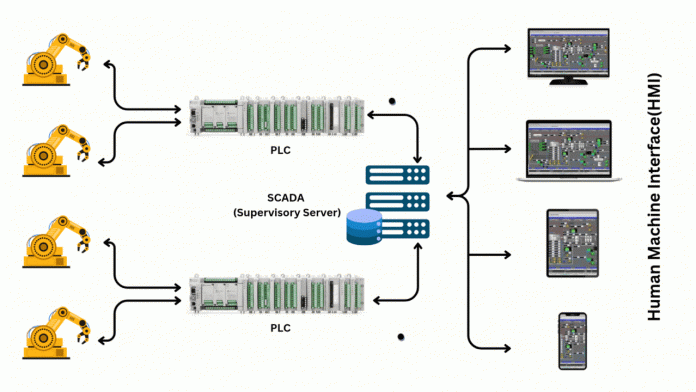

Industries rely significantly on digital technologies to monitor machinery, streamline processes, and guarantee production in today’s increasingly automated environment. Two critical components in industrial automation are SCADA (Supervisory Control and Data Acquisition) and HMI (Human-Machine Interface). While often used together and sometimes interchangeably, they serve distinct yet complementary roles in modern industrial control systems. This blog aims to demystify what SCADA HMI is, how it works, and why it’s indispensable in sectors like manufacturing, energy, water treatment, and more.
Understanding SCADA: Supervisory Control and Data Acquisition
The purpose of SCADA, a centralized software system, is to monitor and manage machinery and operations in expansive industrial settings. It connects with hardware devices like PLCs (Programmable Logic Controllers) and RTUs (Remote Terminal Units) to collect real-time data from sensors, valves, motors, and other field instruments.
Understanding HMI: Human-Machine Interface
The HMI is the visual and interactive interface between humans (operators or engineers) and machines (control systems). It provides graphical representations of the process being monitored and controlled, typically using screens, buttons, charts, and alarms.
Key Features of HMI:
- Touchscreen Interface – enables users to use touch commands to engage with the system..
- Graphical Displays – Provides intuitive visuals of machinery, tanks, conveyors, or entire plants.
- Status Indicators – Shows live updates on equipment performance and system status.
- Alarm Notifications – Highlights critical conditions in real time.
- Navigation Panels – Enables users to access different parts of the control system quickly.
HMIs can range from basic operator panels to sophisticated, multi-touch industrial displays running high-level visualization software.
How SCADA HMI Works Together
In a complete industrial automation setup:
- Field devices like sensors or motors send data to a PLC/RTU.
- The SCADA system reads this data and processes it in real time.
- The operator can view the data using a graphical user interface on the HMI.
- The operator can then issue commands through the HMI (like turning a pump on/off).
- SCADA logs the command and executes it via the control system.
Together, SCADA and HMI allow for real-time monitoring, control, and decision-making in complex industrial environments.
Benefits of Using SCADA HMI Systems
SCADA HMI systems provide a range of benefits across industries:
1. Operational Efficiency :-Operators can manage entire processes from a centralized control room, reducing the need for manual checks or physical interventions.
2. Real-Time Monitoring :- Live data helps prevent downtime by enabling quick response to abnormalities or faults.
3. Enhanced Safety :- Alarm systems and status indicators reduce the risk of accidents by alerting operators to unsafe conditions.
4. Data-Driven Decision Making :-Historical data analysis enables predictive maintenance, production optimization, and quality improvements.
5. Remote Access :-Modern SCADA systems often support remote access, allowing engineers to monitor and control systems from smartphones, tablets, or remote desktops.
The Future of SCADA HMI
As industries embrace Industrial IoT (IIoT) and Industry 4.0, SCADA HMI systems are evolving with features like:
- Cloud Integration
- Mobile and Web-Based HMIs
- AI and Predictive Analytics
- Cybersecurity Enhancements
- Edge Computing for Real-Time Control
These innovations aim to make SCADA HMI systems more scalable, secure, and intelligent, meeting the demands of modern industrial environments.
Conclusion
SCADA HMI systems are the backbone of industrial automation, offering the visibility and control needed to manage complex operations efficiently and safely. While SCADA provides powerful supervisory functions, HMI delivers the user-friendly interface that makes real-time interaction with machines possible. Together, they ensure that industries can operate smoothly, adapt quickly, and make informed decisions in a fast-paced world.
Whether you’re a systems integrator, plant operator, or automation engineer, understanding SCADA HMI is crucial for designing and maintaining smart, connected industrial systems.